Autism & MEYA: understanding the intersection of autism and anxiety
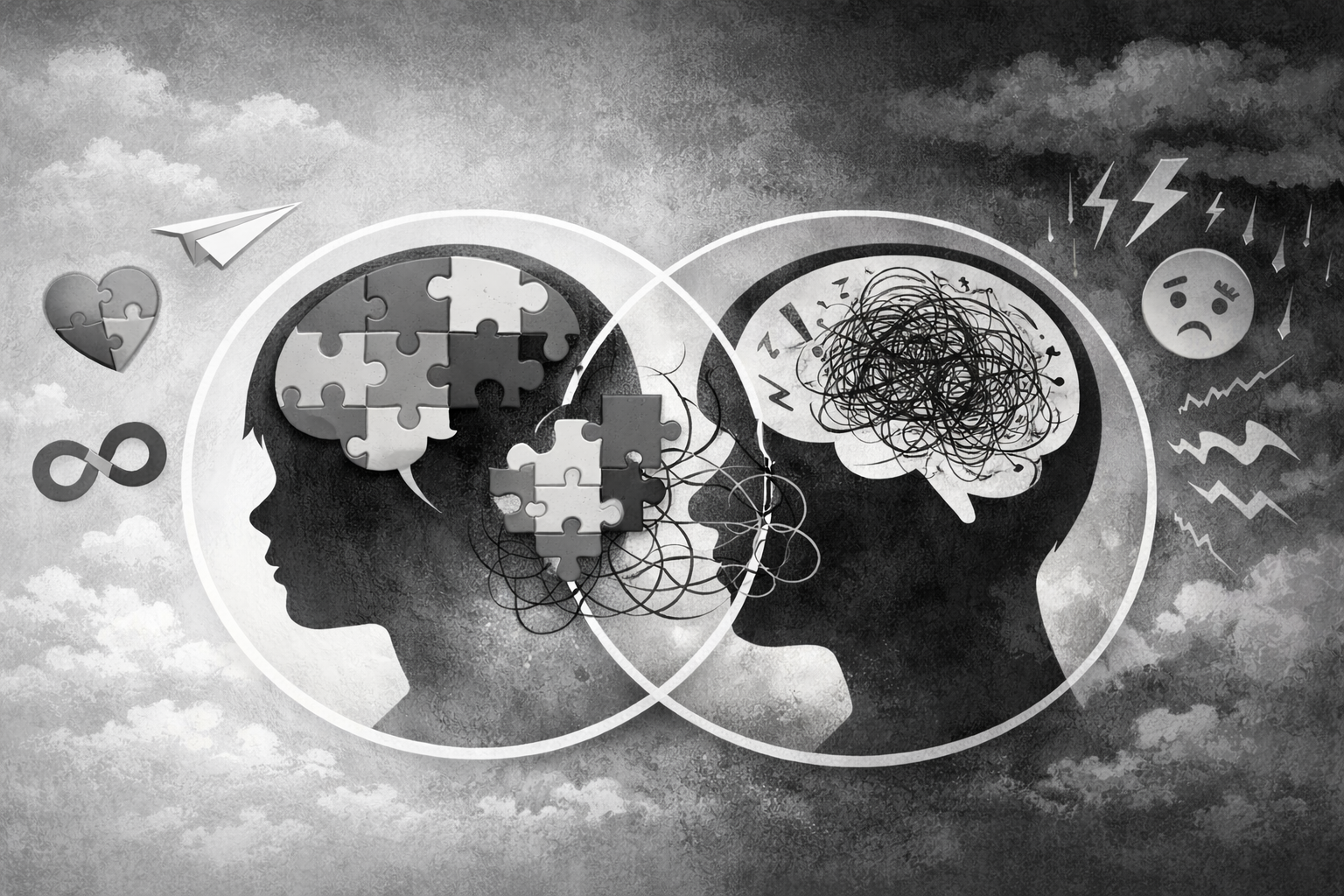
Like many children, autistic children often struggle with anxiety as they begin to navigate increasingly complex social relationships, goals, and expectations, with up to 80% of autistic youth having a co-occurring internalizing difficulty. An important question for researchers to consider when developing anxiety treatments for autistic children is whether anxiety impacts their lives in the same way as their neurotypical peers. Research suggests that the intersection between autism and anxiety is uniquely important, as children who have both face a higher degree of challenges with adaptive functioning, social skills, loneliness, behavioral challenges, self-injurious behavior, and family problems (Johnson et al., 2023). Furthermore, the specific challenges autistic children face varies widely between individuals, making it difficult to apply a single treatment broadly. To make manners more complicated, clinicians often struggle to identify anxiety disorders when the causes overlap with symptoms that are common for autistic children. For example, autistic children often experience social challenges, which can result in a higher level of self-consciousness due to negative peer interactions.
Cognitive-behavioral therapy (CBT) is one treatment which has been found to be effective for reducing anxiety in neurotypical children. Coping Cat is one example of a CBT program that has been found to be highly effective for treating anxiety in neurotypical children (Podell et al., 2010). CBT usually involves teaching children how to use cognitive strategies that encourage reframing thinking in anxiety inducing situations, thus helping them through exposure exercises and cognitive restructuring of thoughts. Considering the co-occurrence of autism and anxiety is high, a need for adapted forms of behavioral therapies for autistic youth is needed.
With this, Wood et al (Wood et al., 2024) created a modular and adapted version of traditional CBT curriculum for autistic youth. Considering individuals vary widely in their clinical need, MEYA utilizes a clinical decision-making algorithm to make recommendations for specific modules that best reflect the client’s current need. MEYA, overall, is a free to use web-based CBT tool that provides adaptable therapy practices for clinicians who work with youth with autism and anxiety. In practice, clinicians use MEYA as a tool to structure their sessions, learn new information, and use materials from the site itself for their client’s treatment plan. The modular practices employed by MEYA have helped to close the gap for treating anxiety in autistic youth, as research has found it to be as effective as traditional CBT programs are for typically developing children.
What does the future of anxiety treatment for autistic children look like? A crucial next step is to take the modular practices provided by MEYA and implement them in community settings. MEYA needs to be tested by clinicians to see if it can reduce anxiety in their autistic patients better than standard care practices. This would be the most straight forward route to improve the accessibility and scalability of effective anxiety treatment for autistic children. The adaptable nature of MEYA also lends itself to being expandable into new areas. For example, autistic children who are minimally verbal or have co-occurring intellectual disability could benefit from an adapted version of MEYA. Ultimately, the unique intersectionality of autism and anxiety is an important lesson that teaches us how anxiety can manifest in different ways. Embracing these differences and integrating them into therapy practices that are backed up by evidence is a promising path forward for helping autistic children who struggle with anxiety.
Johnson, A. R., Wolpe, S., Tien, I. S., Muscatello, V. S., & Wood, J. J. (2023). Chapter 16—Cognitive-behavioral therapy for children with autism and anxiety. In C. R. Martin, V. B. Patel, & V. R. Preedy (Eds.), Handbook of Lifespan Cognitive Behavioral Therapy (pp. 181–191). Academic Press. https://doi.org/10.1016/B978-0-323-85757-4.00007-9
Podell, J. L., Mychailyszyn, M., Edmunds, J., Puleo, C. M., & Kendall, P. C. (2010). The Coping Cat Program for Anxious Youth: The FEAR Plan Comes to Life. Cognitive and Behavioral Practice, 17(2), 132–141. https://doi.org/10.1016/j.cbpra.2009.11.001
Wood, J. J., Wood, K. S., Rosenau, K. A., Cho, A. C., Johnson, A. R., Muscatello, V. S., Tien, I. S., Straus, J., Wolpe, S., Zeldin, A., Kazlauskas, K., & McLeod, B. D. (2024). Practitioner Adherence and Competence in MEYA, a Free Online Self-Instruction Program in Modular Psychotherapy and Counseling for Children’s Autism-Related Clinical Needs. Journal of Autism and Developmental Disorders. https://doi.org/10.1007/s10803-023-06226-w
Jeff Anderson & Ingrid Tien
UCLA- MEYA Autism Program